In this guide
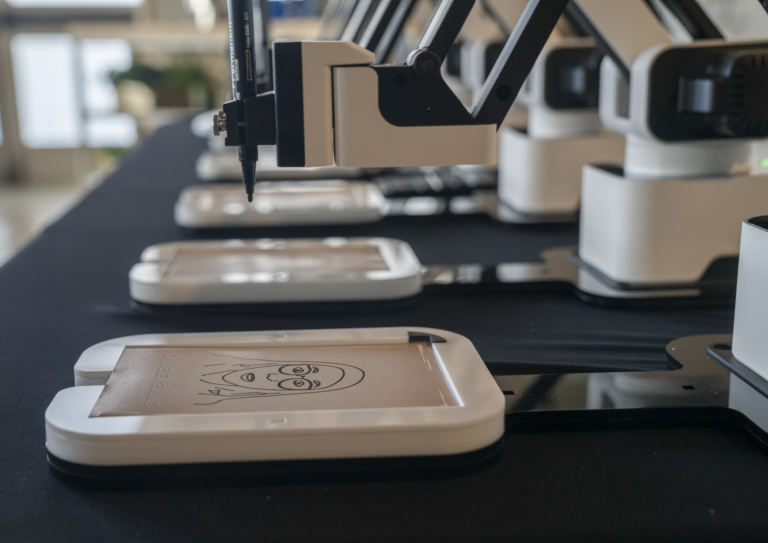
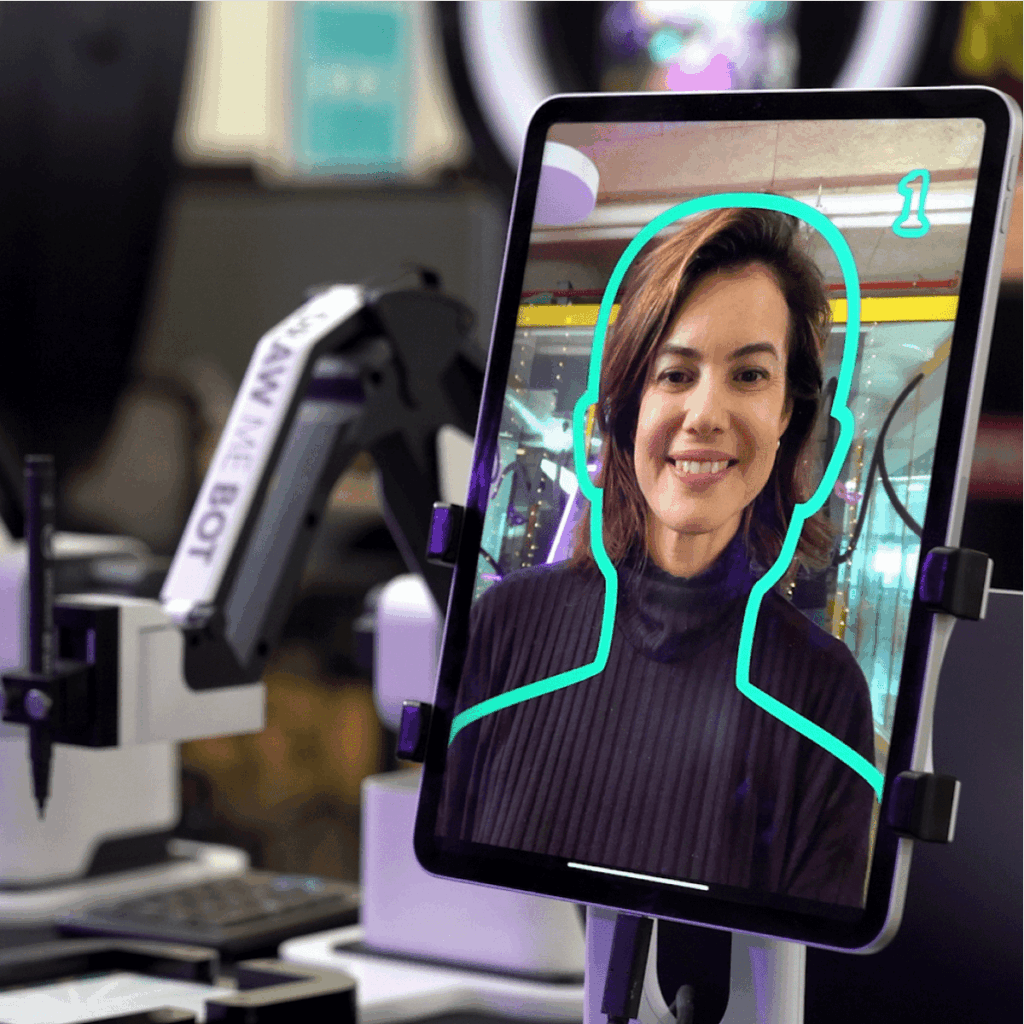
Featured image: Equipment demonstration showing the photo tablet and drawing robot.
You can spend heavily on booth graphics and still watch people walk past.
That is because a trade show booth has two different jobs:
First, give the right attendee a reason to stop.
Then give them a reason to stay long enough for a useful interaction.
Those are not the same problem.
A huge backdrop may make your company visible without making the booth approachable. A giveaway may attract people who have no interest in your product. An elaborate activity may create a line while leaving your sales team wondering how to turn participants into conversations.
The strongest trade show booth ideas connect four things:
relevance, attraction, participation and conversation.
Start there.
From attention to conversation
- NoticeMessage / movement
- UnderstandObvious activity
- ParticipateLow-friction action
- ConverseHuman handoff
Trade show booth ideas at a glance
You do not need all eight.
You need a combination that suits the people you actually want to meet.
Before you choose an attraction, decide who you want to stop
“More traffic” sounds like an obvious goal.
But more traffic is not always the useful goal.
Suppose 400 people visit your booth because you are giving away an expensive consumer product, but almost none of them are potential buyers.
Now compare that with 80 visitors who understand what your company does and include 20 people your sales team genuinely wants to meet.
Which booth performed better?
That depends on your objective.
Before planning the attraction, write down:
- who you want to meet;
- what problem they are likely trying to solve;
- what you want them to understand about your company;
- what you want to happen after they stop.
This matters because relevance still plays a major role in booth selection. IAEE’s 2026 research into younger professionals found product relevance was the top reason for visiting a booth, and 63% of that studied group said they pre-planned their show-floor navigation. IAEE research overview and IAEE’s published discussion
The lesson is not “make everything entertaining.”
It is:
Give the right person a clear reason to put you on their list—and another reason to stop when they reach you.
1. Make one message understandable from the aisle
Start with the least exciting idea on this list.
It may also be one of the most important.
Someone walking past your booth should be able to understand why your company might matter to them without stopping to read a paragraph.
That usually means one clear message.
Not:
SERVING INDUSTRY SINCE 1987
That tells an attendee something about you, but very little about why they should stop.
A stronger message answers a visitor’s question:
“What can these people help me with?”
For a fictional commercial roofing software company, for example:
Know which roof needs attention before it becomes an emergency.
Now a property manager has a reason to look closer.
Try the aisle test
Before the show, stand well back from your display.
Ask someone unfamiliar with the company to look at it briefly.
Then ask:
“What do you think we do?”
If the answer is nowhere close, the solution probably is not more copy.
Simplify.
Your logo matters. Your visual identity matters. But neither replaces a clear reason to approach.
2. Put the product in motion
If your product can be demonstrated, demonstration is usually more interesting than explanation.
Do not hide the best part behind a sales conversation.
Make something visible.
That could mean:
- a machine operating;
- software completing a real task;
- equipment being tested;
- a material being cut or assembled;
- a before-and-after process;
- a short live workflow;
- a physical product attendees can handle.
CEIR’s current North American research specifically examines product engagement as an important part of effective in-booth interaction rather than treating the exhibit as a static display. CEIR
The key is to make the demonstration understandable quickly.
If it takes an eight-minute explanation before the interesting thing happens, most people walking the aisle will never see it.
Ask:
What is the most visually understandable 30 seconds of what we do?
Show that.
Then let the deeper conversation happen afterwards.
3. Use a live personalized activity
Sometimes the company itself does not have a visually interesting product to demonstrate.
An accounting firm, insurer, professional service company or software platform may have an excellent offering without anything obvious moving in the booth.
That is where an outside activation can help.
The useful ones give people:
- something they can understand from the aisle;
- a simple reason to participate;
- enough time for staff to begin a natural conversation.
Robo Portraits is one example.
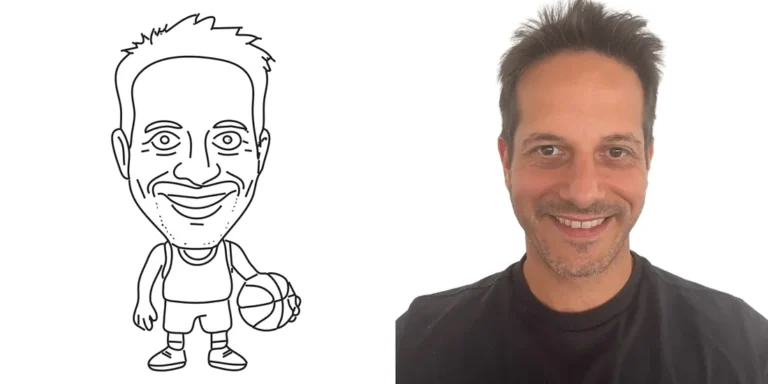
A visitor has a photo taken and chooses a portrait style. A physical robot then draws the portrait in pen while the visitor and people nearby can watch.
The guest leaves with the physical drawing.
The robot movement is the visible part of the attraction. The portrait gives the visitor a personal reason to participate.
See how the Robo Portraits drawing process works
Where it can fit a trade show booth
Do not put the robot somewhere people cannot see it until they have already entered the booth.
If watching the drawing is supposed to create curiosity, position the experience so that the active part can be seen from normal attendee traffic.
At the same time, do not create a layout where people watching the activity block the aisle or prevent serious prospects from reaching your team.
Your activation and your conversations need to coexist.
Plan the capacity
Robo Portraits uses approximately 22 portraits per robot-hour as a conservative planning assumption.
Approximate two-hour capacity is:
| Robots | Approximate portraits |
|---|---|
| 1 | 45 |
| 2 | 90 |
| 3 | 130 |
Trade shows are quoted differently from private events because operating hours, attendance, booth layout and required capacity vary considerably.
Trade show and brand-activation pricing is upon request.
A full-day trade show will typically be scoped around three robots, but the actual recommendation depends on the show and the drawing window.
Do not treat portrait capacity as a guarantee that every person attending the conference will receive one.
Plan around the number of people you realistically want to serve.
See Robo Portraits for trade shows and brand activations
4. Give attendees a challenge they can understand in seconds
Games can work extremely well on a show floor.
They can also become completely disconnected from the business.
A good booth challenge should pass three tests:
Is it obvious?
Can someone understand what to do without a long explanation?
Is it quick?
Can people participate without committing a large portion of their show-floor time?
Does it create a useful transition?
Is there an obvious way for your staff to talk with them afterwards?
Examples could include:
- a short skills challenge;
- a product-related quiz;
- a timed task;
- a simple guessing challenge;
- an industry-knowledge question;
- a leaderboard activity.
You do not necessarily need to force your product into the game.
Sometimes that becomes awkward.
But the attraction should at least suit the audience and the brand.
A serious professional-services organization does not need to turn its booth into a carnival simply because games can attract people.
5. Teach one useful thing in five minutes
Not every good booth attraction needs entertainment.
Expertise can be the attraction.
A useful short session might be:
“Three changes coming to Manitoba construction contracts this year.”
Or:
“Five things to check before buying industrial equipment.”
Or:
“Bring us your current packaging and we’ll show you where the shipping cost is coming from.”
The key is specificity.
“Come learn about our innovative solutions” is advertising.
A small, useful promise gives an attendee a reason to stop.
CEIR’s research on exhibition-floor engagement treats learning and interaction with knowledgeable people as meaningful components of the in-person experience. IAEE
Keep these sessions short enough for the show floor.
This is not a conference breakout room.
You want someone to think:
“I can learn something useful in a few minutes.”
Not:
“I seem to have accidentally enrolled in a seminar.”
6. Put your best people where visitors can actually talk to them
The activity gets too much credit when trade-show planning goes wrong.
Your booth staff still matter.
A robot, game, coffee bar or demonstration can give someone a reason to approach.
It cannot have the business conversation for you.
IAEE’s 2026 guidance based on its next-generation attendee research emphasizes friendly, consultative and knowledgeable booth staff—and warns against aggressive aisle approaches and disengaged staff looking at their phones. IAEE
That suggests a very practical booth design rule:
Do not hide your useful people behind furniture.
Avoid creating a wall of staff standing shoulder-to-shoulder behind a table.
Give attendees a comfortable way to step into the space.
And train staff on the transition from attraction to conversation.
For example, if someone is watching a robot draw their portrait, the opening should not immediately be:
“Can I scan your badge?”
A better transition may simply be:
“What brought you to the show?”
Then listen.
The attraction has already solved the awkward first few seconds.
Do not recreate the awkwardness yourself.
7. Make the takeaway earn its place
Trade-show giveaways are not inherently bad.
A useful item can be useful.
The problem comes when the giveaway is completely disconnected from the interaction.
If the entire process is:
take pen → leave booth
you have successfully distributed pens.
You have not necessarily created a meaningful booth visit.
Think of the takeaway as the last step of the experience, not the first.
Ask:
Why would someone want this particular thing from us?
That could mean:
- something genuinely useful to your audience;
- a small reference tool related to their work;
- a personalized item;
- a useful printed resource;
- a physical result from an activity.
With Robo Portraits, the takeaway is the portrait that the attendee watched being drawn.
Standard portraits are created on Robo Portraits cards. Custom cards using the client’s design are available as an optional add-on.
That creates a logical sequence:
I stopped because I saw the robot → I participated → I watched the drawing → I left with the portrait.
8. Give people a reason to find the booth before the show opens
Not every attendee should discover you accidentally.
Trade-show attraction begins before the exhibit hall opens.
If you know which people you want to meet, tell them why your booth is worth visiting.
That could include:
- invitations to existing prospects or clients;
- pre-booked demonstrations;
- appointments with subject-matter experts;
- a scheduled mini-session;
- a product launch;
- a specific booth activity available during certain hours.
IAEE’s 2026 younger-professional research found substantial pre-planning of show-floor visits, which reinforces the value of strong exhibitor descriptions and pre-event communication. IAEE
Do not send:
“Come visit us at Booth 417!”
Give them the reason.
“We’re demonstrating the new inspection system at Booth 417 at 11:00 and 2:00.”
or:
“We’re running live robot-drawn portraits throughout the expo. If you’re at the show, come watch one being drawn.”
Now the booth number has a purpose.
Design the booth from the aisle inward
One useful planning exercise is to imagine the booth from the attendee’s point of view.
They approach in four stages.
A generic booth-flow sketch
↓ Visible attractionLet passersby see the active part.
Spectator / waiting areaPlan space inside the booth for watching and waiting.
↓ Direct access to staffKeep a clear route from the aisle to your team.
Conversation zoneLet product conversations continue alongside the activity.
1. Twenty feet away: Why should I look?
This is your:
- headline;
- product movement;
- unusual visual;
- demonstration;
- crowd activity.
They should not need to read six bullet points yet.
2. At the aisle: What is happening?
They should be able to understand the basic interaction.
Try the product.
Watch the demo.
Get a portrait drawn.
Take the challenge.
Ask the expert.
If it is confusing, the activation loses much of its value.
3. Inside the booth: Who should I talk to?
Make it easy for the visitor to move from activity to conversation.
Do not make prospects fight through a queue to reach your sales team.
Do not place all staff behind the attraction.
Think about the physical path.
4. Leaving: What happens next?
The next step might be:
- a scheduled meeting;
- a promised follow-up;
- a product trial;
- a specification sheet;
- a useful takeaway;
- simply a good conversation worth continuing.
Not every visitor needs the same next step.
That is why the humans in the booth still matter.
A crowd is not the same thing as a successful booth
This deserves its own section.
A busy booth can look successful.
Sometimes it is.
Sometimes it is full of people waiting for something free.
Judge the attraction by what it helps your team accomplish.
Useful measures might include:
- meaningful conversations;
- meetings booked;
- demonstrations completed;
- target accounts engaged;
- useful follow-ups created;
- activity participation, when awareness itself is the objective.
CEIR reported that 81% of exhibitors in its 2024 research evaluate the effectiveness of attendee-engagement activities. CEIR
The exact measurement should follow your objective.
If the company is launching an unfamiliar consumer brand, broad participation may be valuable.
If you sell specialized industrial equipment to 50 potential buyers in Canada, the number of relevant conversations may matter far more than total booth traffic.
Do not let the attraction take over the booth
There is a subtle failure mode with interactive booths.
You book something popular.
People arrive.
The activity gets busy.
And suddenly the company itself disappears.
Avoid that.
The attraction should create a natural path toward the brand rather than become an unrelated event happening inside rented floor space.
Before the show, answer:
Where will our sales team stand?
When do they enter the conversation?
Can someone interested only in our product reach us without participating?
Can people watch without blocking the aisle?
Where does any queue go?
What happens during peak traffic?
Your exhibit designer, show organizer and activation provider should all understand that plan.
Plan the queue before you have one
Any booth experience that takes individual turns has a capacity limit.
That includes:
- portraits;
- games;
- simulations;
- product trials;
- consultations;
- demonstrations.
You do not need to eliminate every line.
But you should know what happens when the attraction is busy.
Consider:
- where people wait;
- whether the waiting area blocks the aisle;
- whether spectators can see without joining the line;
- whether staff can still reach prospects;
- how long one interaction takes;
- how capacity changes during peak periods.
For Robo Portraits, the conservative planning assumption is 22 portraits per robot-hour, and the trade-show scope can be adjusted around the expected drawing window.
See our capacity-planning guide for robot count, drawing time and participation estimates.
The best booth attraction may be your own product
This is important for an entertainment company to say.
If you manufacture something fascinating, let people watch it work.
If you have software that solves an obvious problem in 30 seconds, demonstrate it.
If your technical expert can diagnose a problem an attendee brings to the booth, use that.
You may not need outside entertainment.
An activation is most useful when your own offering does not naturally create a visible reason for people to stop, or when you want an additional layer of participation around the product.
Do not hide a great product behind a gimmick.
Where Robo Portraits fits a trade show
Robo Portraits can be used as a staffed booth activity where attendees:
- have a photo taken;
- choose a portrait style;
- watch a robot draw the portrait in pen;
- take the physical drawing with them.
The movement of the robot gives passersby something visible to watch, while the portrait gives the participant a personal takeaway.
Trade shows and brand activations are custom quoted.
A full-day trade-show setup will typically use three robots, but the appropriate configuration depends on operating hours, expected participation and event conditions.
For capacity planning, use approximately 22 portraits per robot-hour.
Custom cards using your organization’s design are available as an optional add-on.
Digital copies can be arranged on request before the event; they are not a standard inclusion.
Travel is included within Winnipeg and up to 30 km beyond the Perimeter. Events outside Manitoba require an inquiry.
See the trade show activation service
Planning a trade show?
For a useful quote, send Robo Portraits:
your show dates, location, expected attendance or booth traffic, booth details and the hours you want the drawing activity running.
If you already know whether the goal is broad participation, targeted prospect engagement or a sponsor/VIP area, include that too.
Those details are more useful than simply saying, “We have a trade show.”
Tell Robo Portraits about your event
Frequently asked questions
What actually attracts people to a trade show booth?
There is no single attraction that works for every audience.
Start with relevance: attendees need to understand why the company matters to them. Then give them a clear reason to stop, such as a demonstration, activity, useful expert, challenge or personalized experience.
The attraction should make it easier—not harder—for booth staff to start a meaningful conversation.
Is a giveaway enough to attract attendees?
It can attract people.
That does not necessarily mean it attracts the people you want.
A giveaway is more useful when it connects to the booth interaction or gives the attendee something genuinely relevant.
Should an interactive attraction go at the front of the booth?
It should be visible enough to do its job without blocking access.
The exact position depends on your footprint, aisle traffic, queue and other booth elements.
Plan where spectators and waiting participants will stand before finalizing the layout.
How many Robo Portraits robots do we need for a trade show?
It depends on the drawing hours and intended participation.
Use approximately 22 portraits per robot-hour for planning.
A three-robot setup therefore has substantially more capacity than one or two robots, and three robots are typical for a full-day trade-show scope.
Our capacity-planning guide explains the calculation for different drawing windows and participation targets.
How much does Robo Portraits cost for a trade show?
Pricing is upon request.
Trade shows and brand activations are custom quoted because the operating hours, robot count, event duration, branding and travel requirements vary.
Your quote shows every line before you book.