In this guide
If you have 100 guests, do you need enough capacity for 100 portraits?
Not necessarily.
That is the most important thing to understand when planning Robo Portraits.
At a small birthday party, you may want every guest drawn.
At a wedding, company party or gala, Robo Portraits may be one of several things happening. Some guests will be eating, dancing or talking. Some will watch the robot without getting a portrait.
So do not start with:
“How many people are attending?”
Start with:
“How many people do we want to be able to draw?”
Then use a simple planning formula.
The Robo Portraits capacity formula
For conservative planning, use:
Required robots = round up [desired portrait participants ÷ (22 × drawing hours)]
The 22 represents approximately 22 portraits per robot-hour.
It is a planning assumption, not a guarantee that exactly 22 portraits will be completed every hour. Actual numbers depend on portrait style and event conditions.
The calculation tells you how many robots you would need for your participation target and drawing window.
Robo Portraits can use up to three active robots at an event.
If the formula gives you more than three robots, do not assume a larger fleet is available. Instead, consider:
- a longer drawing window;
- a lower participation target; or
- a custom capacity discussion.
The quick answer
If your event is two hours and you want nearly everyone to have the opportunity to receive a portrait:
| Total guests | Portrait target | Two-hour starting point |
|---|---|---|
| 50 | About 50 | 2 robots |
| 100 | About 100 | 3 robots |
| 200 | About 200 | More time required |
But those answers change quickly if you do not need portraits for everyone.
For example, a 200-person gala where you want about 100 portraits can work very differently from a 200-person event where receiving a portrait is a central part of the evening.
That is why participation comes first.
How much can 1, 2 or 3 robots draw?
Using the conservative 22-portraits-per-robot-hour assumption:
| Drawing time | 1 robot | 2 robots | 3 robots |
|---|---|---|---|
| 2 hours | 44 | 88 | 132 |
| 3 hours | 66 | 132 | 198 |
| 4 hours | 88 | 176 | 264 |
For public package descriptions, the two-hour numbers are rounded to approximately:
- 1 robot: 45 portraits
- 2 robots: 90 portraits
- 3 robots: 130 portraits
So when you see “about 90 portraits” for a two-robot package, it comes from the same conservative planning approach.
Do not treat those numbers as promises. They are there to help choose an appropriate setup.
First decide what percentage of guests you want to draw
For the examples below, we will test three hypothetical participation targets:
- 50% of attendees
- 70% of attendees
- everyone
These are planning scenarios only.
They are not predictions of how many guests will participate.
A 70% target does not mean Robo Portraits expects 70% of guests to get portraits. Your event may be higher or lower.
The percentages simply let you test different goals before booking.
Try your guest count and drawing window
Choose a portrait target, not a predicted participation rate. The tool uses 22 portraits per robot-hour and rounds robot requirements up.
Example: 200 guests × 70% = 140 portrait participants.
Add drawing time
A two-hour window exceeds the standard three-robot planning limit. For this target, three hours calls for 3 robots; four hours calls for 2 robots.
These are planning estimates, not guaranteed portrait counts. Individual portraits are the planning basis; styles, groups and event conditions can change the actual numbers. Leave room above your target.
If you have 50 guests
A 50-person event is small enough that one robot may be all you need—unless you want nearly everyone drawn during a short window.
Scenario A: 25 portraits
You have 50 guests, but Robo Portraits is one optional activity and you would be satisfied with capacity for about half the room.
Desired portraits: 25
For two hours:
25 ÷ (22 × 2)
= 25 ÷ 44
= 0.57
Round up:
1 robot
One robot is comfortably within the planning target.
Recommendation
1 robot for 2 hours gives approximate capacity for 45 portraits.
That gives considerably more capacity than your 25-portrait target.
Scenario B: 35 portraits
Suppose you want capacity for roughly 70% of the 50 guests.
Desired portraits: 35
For two hours:
35 ÷ 44 = 0.80
Round up:
1 robot
Recommendation
1 robot for 2 hours still works.
You do not need a second robot simply because 50 people are attending.
Scenario C: all 50 guests
Now receiving a portrait is important and you want capacity for all 50 people.
For two hours:
50 ÷ 44 = 1.14
Round up:
2 robots
Two good options
Option 1: 2 robots × 2 hours
Planning capacity:
2 × 2 × 22 = 88 portraits
Public package capacity is approximately 90 portraits.
That gives plenty of breathing room and allows two portraits to be drawn simultaneously.
Option 2: 1 robot × 3 hours
Planning capacity:
1 × 3 × 22 = 66 portraits
This also covers a 50-person target, but participation is spread across a longer period.
Which is better?
If most of your 50 guests will want portraits during the same two-hour party window, two robots give you more simultaneous capacity.
If guests will participate gradually over a longer event, one robot for longer may be sufficient.
Same attendance.
Different event flow.
50-guest summary
| Intended participation | Portrait target | 2 hours | 3 hours |
|---|---|---|---|
| 50% | 25 | 1 robot | 1 robot |
| 70% | 35 | 1 robot | 1 robot |
| 100% | 50 | 2 robots | 1 robot |
For a 50-person birthday where everyone getting a portrait matters, plan differently than you would for a 50-person reception where Robo Portraits is simply one activity.
If you have 100 guests
This is where distinguishing attendance from participation becomes especially useful.
Two robots over two hours provide approximately 90 portraits.
That might be more than enough—or slightly less than your goal.
Scenario A: 50 portraits
Suppose you have 100 guests and would like capacity for about half.
For two hours:
50 ÷ 44 = 1.14
Round up:
2 robots
Recommendation
2 robots for 2 hours provides approximately 90 portraits of public planning capacity.
Alternatively:
1 robot × 3 hours × 22 = 66 portraits
So 1 robot for 3 hours also covers the 50-portrait target if the longer operating window fits your event.
Again, the choice depends on whether demand is concentrated or spread out.
Scenario B: 70 portraits
You want capacity for roughly 70 of the 100 guests.
For two hours:
70 ÷ 44 = 1.59
Round up:
2 robots
Recommendation
2 robots for 2 hours.
Approximate public capacity: 90 portraits.
That gives reasonable room above the 70-person target without automatically moving to three robots.
If the activity can operate for four hours:
1 robot × 4 hours × 22 = 88 portraits
One robot could theoretically cover the same participation target over the longer window.
But total capacity is not the only consideration.
If 60 people appear within the first hour, the four-hour total does not prevent a lineup.
Scenario C: all 100 guests
Now getting nearly everyone drawn matters.
For two hours:
100 ÷ 44 = 2.27
Round up:
3 robots
Option 1: 3 robots for 2 hours
Planning arithmetic:
3 × 2 × 22 = 132
Public two-hour capacity is rounded to approximately 130 portraits.
That provides capacity above the 100-person target.
Option 2: 2 robots for 3 hours
2 × 3 × 22 = 132
The total planning capacity is effectively the same.
But the guest experience can be different.
Three robots over two hours provide more simultaneous drawing capacity.
Two robots over three hours provide the capacity over a longer participation window.
Which should you choose?
Imagine two 100-person events.
At Event A, almost everyone arrives at 6:00 and the activity runs during a two-hour cocktail reception.
At Event B, guests circulate through an open house between 4:00 and 8:00.
Event A benefits more from additional robots.
Event B may benefit more from additional time.
100-guest summary
| Intended participation | Portrait target | 2 hours | 3 hours | 4 hours |
|---|---|---|---|---|
| 50% | 50 | 2 robots | 1 robot | 1 robot |
| 70% | 70 | 2 robots | 2 robots | 1 robot |
| 100% | 100 | 3 robots | 2 robots | 2 robots |
For many 100-person weddings, company parties or galas, the important question is not whether the room contains 100 people.
It is whether getting nearly all 100 people drawn is part of the plan.
If you have 200 guests
At 200 guests, participation assumptions matter a lot.
Three robots are the maximum active setup to assume for standard planning.
That means you cannot simply keep adding robots to solve every capacity problem.
Sometimes the answer is more time.
Scenario A: 100 portraits
You have 200 guests, but Robo Portraits is one of several activities and you want capacity for roughly half.
For two hours:
100 ÷ 44 = 2.27
Round up:
3 robots
Option 1: 3 robots for 2 hours
Public approximate capacity:
130 portraits
That clears the 100-portrait target.
Option 2: 2 robots for 3 hours
2 × 3 × 22 = 132 portraits
Almost the same total capacity, spread over an extra hour.
Recommendation
Use the event schedule to decide.
If demand will be concentrated, favour three robots.
If people circulate gradually, two robots over a longer window may work well.
Scenario B: 140 portraits
Now you want capacity for roughly 70% of the 200 guests.
For two hours:
140 ÷ 44 = 3.18
Round up:
4 robots
But standard planning should not assume four active robots are available.
That means the answer is not “book four.”
The answer is:
Change the time or participation target.
Three-hour option
140 ÷ (22 × 3)
= 140 ÷ 66
= 2.12
Round up:
3 robots
Planning capacity:
3 × 3 × 22 = 198 portraits
Four-hour option
140 ÷ (22 × 4)
= 140 ÷ 88
= 1.59
Round up:
2 robots
Planning capacity:
2 × 4 × 22 = 176 portraits
So the choice could become:
3 robots for 3 hours
or
2 robots for 4 hours
Both clear the 140-portrait target.
Which is better depends on how guests move through the event.
Scenario C: all 200 guests
Now the goal is ambitious: capacity for every person attending.
Two hours
200 ÷ 44 = 4.55
Round up:
5 robots
That exceeds the standard maximum.
A two-hour window is not the right plan.
Three hours
200 ÷ 66 = 3.03
Round up:
4 robots
Still above the three-robot maximum.
Three robots over three hours provide:
3 × 3 × 22 = 198 portraits
That is extremely close to 200 mathematically, but it is not sensible to promise capacity for all 200 when the conservative planning figure itself comes out below the target.
Do not plan an event right on that edge.
Four hours
200 ÷ 88 = 2.27
Round up:
3 robots
Planning capacity:
3 × 4 × 22 = 264 portraits
Recommendation
If you truly want capacity for all 200 guests, three robots with a longer drawing window is the better starting discussion.
If four hours does not fit the program, ask whether nearly everyone actually needs a portrait.
For example, if the real target is 180 portraits:
180 ÷ (22 × 3)
= 2.73
Round up:
3 robots for 3 hours
That changes the plan significantly.
200-guest summary
| Intended participation | Portrait target | 2 hours | 3 hours | 4 hours |
|---|---|---|---|---|
| 50% | 100 | 3 robots | 2 robots | 2 robots |
| 70% | 140 | Add time / custom discussion | 3 robots | 2 robots |
| 100% | 200 | Add time / custom discussion | Add time / custom discussion | 3 robots |
Any result requiring more than three robots should trigger a capacity discussion rather than an assumption that a larger fleet is available.
The most useful table on this page
If you just want to compare common portrait targets:
| Portraits you want capacity for | 2 hours | 3 hours | 4 hours |
|---|---|---|---|
| 25 | 1 robot | 1 robot | 1 robot |
| 35 | 1 robot | 1 robot | 1 robot |
| 50 | 2 robots | 1 robot | 1 robot |
| 70 | 2 robots | 2 robots | 1 robot |
| 100 | 3 robots | 2 robots | 2 robots |
| 140 | Add time | 3 robots | 2 robots |
| 180 | Add time | 3 robots | 3 robots |
| 200 | Add time | Add time | 3 robots |
“Add time” means the formula calls for more than three robots during that window.
It does not mean more than three active robots should be assumed available.
More robots and more hours solve different problems
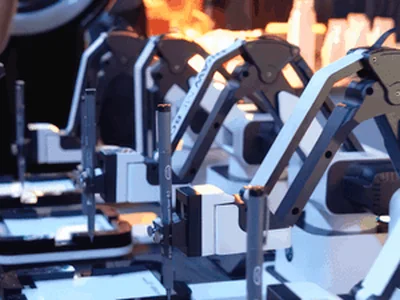
Two setups can have similar total capacity and still produce different experiences.
Consider:
3 robots × 2 hours × 22 = 132 portraits
and:
2 robots × 3 hours × 22 = 132 portraits
Same approximate total.
But they solve different problems.
Add robots when demand is concentrated
More simultaneous drawing capacity can be helpful when:
- the entertainment window is short;
- most guests arrive at once;
- portraits are a major feature of the event;
- you expect strong demand soon after opening;
- there is little opportunity to continue drawing later.
A wedding cocktail hour is a good example.
Everyone may have roughly the same free period.
Add time when participation is spread out
A longer operating window can make sense when:
- guests arrive throughout the event;
- people naturally move between several activities;
- the event itself lasts several hours;
- the drawing station can stay open without competing with important program elements.
A trade show activation is an obvious example.
Attendance may be large, but visitors arrive at the booth throughout the day.
Total capacity does not tell you what the line will look like
Suppose two robots have enough total capacity for your participation target.
That does not mean there will never be a lineup.
If 40 guests decide to participate immediately, demand is temporarily concentrated.
If the same 40 people arrive gradually over three hours, the experience is very different.
That is why we ask about the event format as well as attendance.
Tell us whether guests:
- all arrive together;
- circulate throughout the evening;
- have a specific cocktail-hour window;
- will be seated for long parts of the program;
- will be choosing among several activities.
A good capacity plan is about when demand happens, not only how much demand exists in total.
Portrait style changes how many you can draw
The 22-per-robot-hour number is deliberately conservative.
Actual drawing time changes with the portrait style and event conditions.
That is why we do not recommend building an event plan around the fastest theoretical output.
If maximizing participation is particularly important, tell us.
If portrait detail matters more than volume, tell us that too.
The appropriate setup may be different.
See how robot portrait drawing works and how portrait styles affect the experience.
What about couples, families and group portraits?
The planning formula works best when most portraits are individual portraits.
If you expect many:
- couples;
- families;
- groups;
- other multi-person portraits;
mention that when requesting a quote.
Do not assume a five-person group uses exactly the same amount of drawing capacity as one individual portrait.
If drawing as many guests as possible is important, individual portraits are easier to plan around.
Three examples that look similar—but are not
100-person wedding
Suppose Robo Portraits runs during a two-hour portion of the reception.
If you want about 70 guests to have the opportunity to receive portraits:
2 robots for 2 hours gives approximate capacity for 90 portraits.
If receiving a portrait is important for almost everyone:
3 robots for 2 hours gives approximately 130 portraits of public planning capacity.
See Robo Portraits for weddings.
200-person gala
Suppose Robo Portraits is only one part of the evening and the organizer wants about 100 portraits.
3 robots for 2 hours provides enough planning capacity.
There is no reason to size the station automatically for all 200 attendees.
200-person open house
Now imagine 200 people coming and going over four hours and a target of about 140 portraits.
2 robots for 4 hours provides planning capacity of about 176 portraits.
That may fit the event better than adding simultaneous capacity for a short window.
Same attendance.
Completely different setup.
Use this calculator yourself
You only need three numbers:
- How many portraits do you want capacity for?
- How many drawing hours do you have?
- How many robots does the formula require?
Use:
Desired portrait participants ÷ (22 × drawing hours)
Then round the answer up.
Example
You want capacity for 120 portraits over three hours.
120 ÷ (22 × 3)
= 120 ÷ 66
= 1.82
Round up:
2 robots
Check the capacity:
2 × 3 × 22 = 132 portraits
That gives some breathing room above your 120-person target.
What if the answer is 3.4 robots?
Do not round that to four and assume four robots can be booked.
The standard maximum is three active robots.
Instead:
- increase the drawing time;
- reduce the portrait target; or
- ask us to discuss the capacity requirements for the event.
Do not plan exactly to the mathematical limit
The 22-per-hour assumption is already conservative.
Even so, events are not production lines.
People need to step up, choose styles and move through the experience. Event conditions vary.
If getting every last person drawn is important, give the plan some room.
For example, three robots for three hours have a mathematical planning capacity of:
3 × 3 × 22 = 198
If you have exactly 198 guests and require every single one to receive a portrait, that is an unnecessarily tight plan.
Capacity should help you plan a good guest experience.
It should not become a target the station must hit to the final portrait.
So how many robots should you book?
Use these four questions:
How many people are attending?
How many of them do you want to be able to draw?
How many hours will the drawing station operate?
Will demand happen all at once or gradually?
For a quick starting point:
- 50 guests: often 1 robot; use 2 for a short window when nearly everyone should be drawn.
- 100 guests: often 2 robots; use 3 over two hours if capacity for nearly everyone matters.
- 200 guests: the participation target becomes critical; large targets usually require 3 robots, more drawing time, or both.
Those are planning examples, not fixed package rules.
The formula gives you the first answer.
Your event schedule gives you the final one.
Want us to check the numbers?
Send Robo Portraits:
- your event date;
- location;
- total guest count;
- approximate number of people you want drawn;
- and the drawing window you are considering.
We can then suggest a setup based on the event you are actually planning.
Your quote shows every line before you book.
Frequently asked questions
How many portraits can one robot draw in two hours?
For public planning, approximately 45 portraits.
The underlying conservative calculation is 22 portraits per robot-hour, or 44 over two hours, rounded to about 45.
How many robots do I need for 50 guests?
If you want capacity for all 50 during a two-hour window, use 2 robots.
If you only expect 25–35 portraits, 1 robot for 2 hours provides enough planning capacity.
If one robot can operate for three hours, its planning capacity is approximately 66 portraits.
How many robots do I need for 100 guests?
For a two-hour booking:
- 2 robots provide approximately 90 portraits;
- 3 robots provide approximately 130.
If nearly everyone getting a portrait matters, three robots provide more capacity.
If participation will be lower, two may be enough.
How many robots do I need for 200 guests?
It depends heavily on participation.
For two hours:
- 3 robots provide approximately 130 portraits.
If you want capacity for all 200 people, a two-hour window is not sufficient under the conservative planning formula.
Three robots over four hours provide a planning capacity of approximately 264 portraits.
What if the calculator says I need four or five robots?
Do not assume that number of active robots is available.
Standard planning is based on a maximum of three active robots.
Use a longer drawing window, reduce the desired participation target or ask for a custom capacity discussion.
Does having 200 guests mean I need 200 portraits?
No.
Attendance and intended participation are different numbers.
If Robo Portraits is one of several activities, you may deliberately plan for only part of the room.
If receiving a portrait is a central part of the event, you may want capacity much closer to total attendance.