In this guide
A gala is not just a party with nicer clothes.
The evening may include cocktails, dinner, speakers, awards, an auction or fundraising appeal, sponsor recognition and a social period afterwards.
That means the best entertainment is not necessarily the biggest attraction.
It is the entertainment that fits around the moments that already matter.
A string trio can set the tone as guests arrive. A roaming magician can work during cocktails. Robot portraits can give guests a drop-in activity and physical keepsake. A stage act can create one shared moment. A DJ or band can take over once the formal program is finished.
All of those can work.
Trying to run them at the wrong time can make the evening feel crowded.
Gala entertainment at a glance
The first question is therefore not:
“What entertainment should we hire?”
Ask:
“What does this part of our gala need?”
1. Live music: create atmosphere without creating another activity
Live music can be particularly effective when you want the room to feel active but do not need guests to do anything.
A solo musician, duo, small ensemble or other appropriate live act can work during guest arrival, cocktails or dinner.
The role is atmosphere.
People can continue talking, finding their tables, looking at auction items or greeting colleagues without having to stop for a performance.
It can work well when:
- the cocktail reception is an important part of the evening;
- you want the room to feel polished as guests arrive;
- conversation should remain the main activity;
- the entertainment needs to occupy very little attention.
The most important issue is volume.
If guests are networking, meeting sponsors or catching up with friends, background entertainment should not make conversation difficult.
Ask the musicians what their setup is like in a room similar to yours and talk to the venue about positioning.
A beautiful performance on the wrong side of the room can still create a sound problem.
2. Robot portraits: give guests something to watch and take home
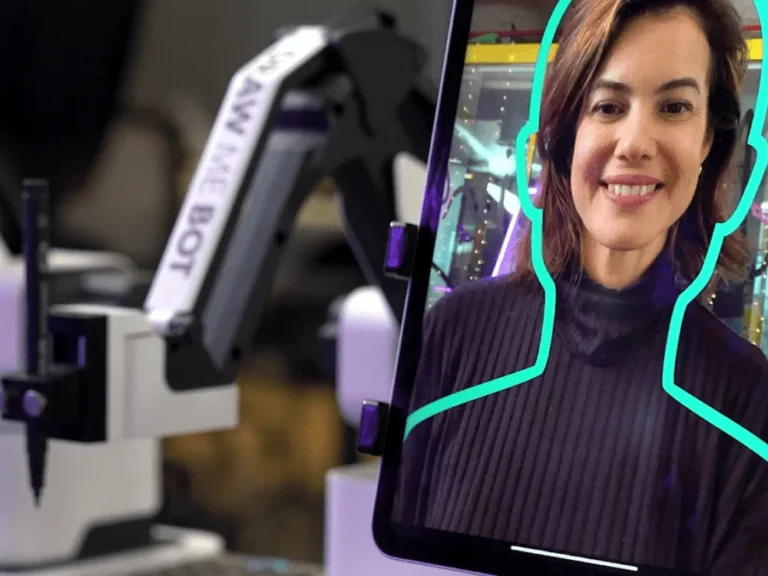
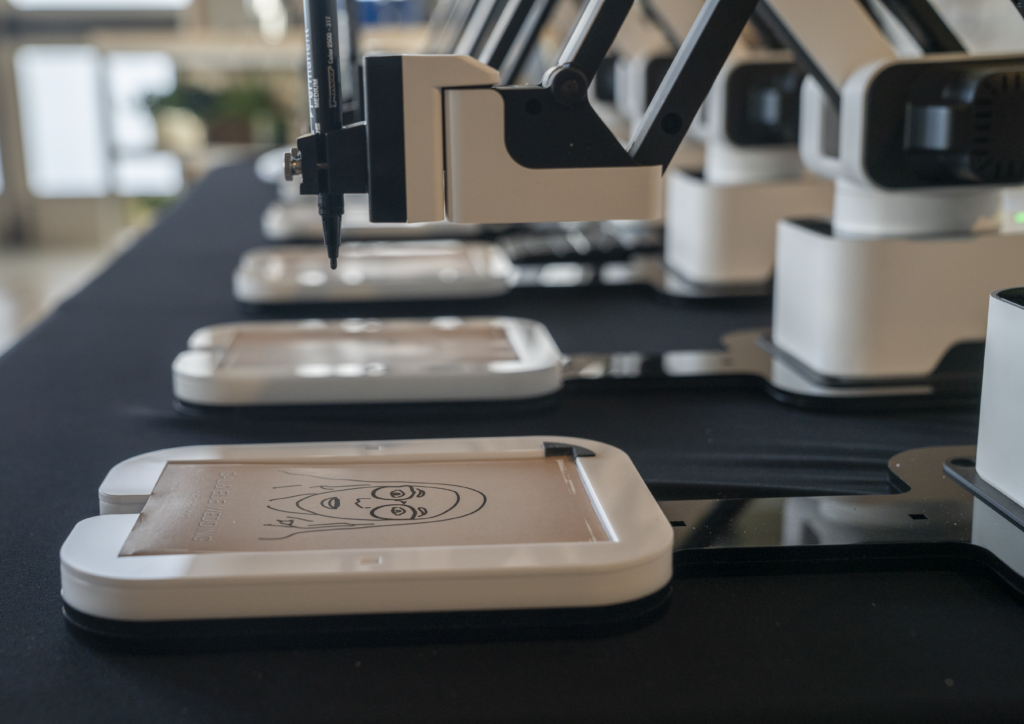
Robo Portraits is a drop-in drawing activity.
A guest has a photo taken, chooses a portrait style and then watches a physical robot draw the portrait in pen.
The guest receives the physical drawing.
The interesting part is not only the finished portrait. Watching the pen move and the drawing develop is part of the attraction.
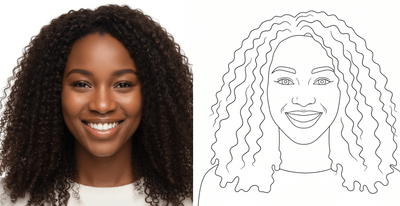
See how a Robo Portrait is created
Where can it fit in a gala?
The most natural windows are periods when guests are already free to circulate:
Cocktail reception: guests can discover the station while mingling.
Between major program elements: if your schedule contains a genuine transition period.
After the formal program: guests who are staying for the social portion have another activity alongside music and conversation.
The important point is that the activity should not compete with the moments where you need the room’s attention.
If the chair, honouree or keynote speaker is on stage, you probably do not want a popular attraction actively drawing people away.
Plan around participation, not total attendance
For conservative planning, Robo Portraits uses approximately 22 portraits per robot-hour.
With the standard gala setup of two robots for two hours, that is approximately 90 portraits.
Three robots over two hours provide approximately 130 portraits.
Those are approximate capacities. They do not mean every guest at the gala is guaranteed a portrait.
At a 250-person gala, your goal might not be to draw 250 people.
Perhaps portraits are one of several optional experiences and you expect 80 to 100 guests to participate.
That is the number worth planning around.
Our capacity-planning guide explains how robot count, drawing time and expected participation fit together.
3. A roaming magician or close-up performer: bring the entertainment to the guests
A roaming entertainer solves a different problem.
Instead of asking guests to visit a station, the performer moves through the room and works with small groups.
That can suit a cocktail reception because people are already standing in clusters.
It can work well when:
- guests are mingling rather than seated;
- you want short bursts of interaction;
- you do not want another fixed station;
- the performer can move around food service, auction displays and other room activity.
The personality of the performer matters as much as the material.
A gala may include major donors, sponsors, employees, community members, clients and invited guests who do not all know one another.
Ask how the performer approaches a group that is already in conversation.
Guests should be able to watch, join in or politely continue their conversation without feeling pressured.
4. A live artist or event painter: let guests watch something develop
Live art can add visual interest without necessarily turning the whole room toward a stage.
But there are at least two very different versions.
One artwork for the organization
An event painter may work throughout the evening on a single scene or piece.
In this version, the appeal is watching the work progress.
The final artwork might commemorate the evening rather than serve as an individual guest takeaway.
Individual drawings for guests
A caricature or sketch artist provides a more participatory experience.
Guests sit or stand for drawings and take their individual artwork home.
The human interaction with the artist is part of the experience.
Before choosing one, decide what you want:
One evolving artwork that becomes part of the event?
Or:
Many individual interactions and keepsakes?
If guests are being drawn individually, ask about realistic hourly capacity before booking. The number of people who can participate matters at a large gala.
If you want individual guest drawings, our robot portraits vs caricature artist comparison explains the differences in interaction, style and capacity.
5. A photo booth: make group photos easy
A photo booth can be a good fit when you want people who arrived together—or met during the evening—to take pictures together.
That is different from an individual portrait activity.
A booth may be the better choice if you picture:
- sponsor teams taking photos;
- colleagues posing together;
- couples having a picture taken;
- guests returning several times with different groups.
Prints, digital delivery, props and backdrops vary by package, so verify what is actually included.
Think about where it goes
At a gala, floor-plan placement matters.
A photo booth should be easy enough to find without interfering with:
- registration;
- auction displays;
- bar lines;
- dinner service;
- entrances and exits;
- access to the main program area.
Also consider what happens to the queue if several groups arrive at once.
If you are deciding specifically between a booth and robot-drawn portraits, the simple distinction is:
Choose the booth when group photographs are the priority.
Consider Robo Portraits when watching the drawing and receiving physical artwork are the priority.
6. A featured stage performance: create one moment everyone shares
Some galas benefit from entertainment that temporarily becomes the program.
That might be a musical performance, comedy, magic, dance, cultural presentation or another stage act appropriate to the audience.
The strength of stage entertainment is focus.
For a period of time, the whole room is experiencing the same thing.
That is also its biggest scheduling constraint.
Do not treat a stage performance as background entertainment.
Give it a real slot.
Plan for:
- how guests will see the performance;
- how they will hear it;
- how long it runs;
- who introduces it;
- what comes immediately before and after it;
- whether audience participation is involved;
- whether the content suits the audience and purpose of the gala.
If the evening includes important speeches or a fundraising appeal, decide which moments deserve the strongest attention and keep them separate.
A gala can have several highlights.
They do not all need to happen at once.
7. A DJ or after-party band: mark the end of the formal program
Some galas change character once the formal portion ends.
Dinner is finished.
Awards have been presented.
The auction or fundraising program is complete.
Now the event becomes more social.
A DJ or band can make that transition obvious.
This works particularly well when:
- guests are expected to stay after the formal program;
- dancing fits the audience;
- the evening has a clear second half;
- the organization wants the night to feel less formal once the program ends.
Not every gala needs dancing.
If your audience is more likely to stay for conversation, music can remain atmospheric instead.
The point is to design the late part of the evening around the guests you actually have rather than copying the format of another event.
Build entertainment around four gala windows
A simple way to plan the evening is to divide it into four windows.
Window 1: Arrival and cocktail reception
Guests are arriving, checking in, finding people they know and looking around the room.
This is a good time for entertainment that works without an announcement.
Examples:
- live background music;
- robot portraits;
- live sketch artist;
- roaming entertainer;
- photo booth.
People can choose whether to participate.
Window 2: Dinner
Dinner already gives guests something to do.
Usually the best entertainment here is subtle.
Music can continue at an appropriate level. A visual artist may continue working. Some optional stations might remain available depending on the schedule and room.
But be careful about creating reasons for everyone to leave their tables while dinner is being served.
Window 3: Formal program
This may contain:
- welcome remarks;
- awards;
- videos;
- speakers;
- an auction;
- a fundraising appeal;
- sponsor recognition;
- a keynote or featured performance.
Decide what the audience should be looking at.
Then protect those moments.
If another attraction is going to compete for attention, pause it or schedule it outside this window.
Window 4: Post-program reception
The pressure changes once the formal agenda is complete.
Guests may dance, return to activities they missed earlier, visit with friends or leave at different times.
This can be a good window for:
- DJ or band;
- portrait station;
- photo booth;
- live artist;
- other optional activities that were paused during the program.
A simple run of show often makes entertainment decisions much easier.
Example: where the entertainment might fit
Consider this hypothetical gala:
| Time | Program | Entertainment approach |
|---|---|---|
| 5:30 p.m. | Doors and cocktails | Live music + optional guest activity |
| 6:30 p.m. | Dinner | Background music |
| 7:30 p.m. | Welcome and awards | Pause competing attractions |
| 8:00 p.m. | Auction / fundraising program | Keep attention on the program |
| 8:45 p.m. | Featured entertainment | One shared room moment |
| 9:15 p.m. | Social reception | Music + optional stations resume |
The exact times do not matter.
The principle does:
Give every part of the evening a job.
Then choose entertainment that helps rather than competes.
If it is a fundraiser, entertainment is not the fundraising strategy
This distinction matters.
Entertainment can give guests something to do.
It can create atmosphere.
It can give the evening another point of interest.
It cannot guarantee that people donate more.
Be wary of planning around an assumed fundraising return from an entertainment expense unless you have evidence from your own event or organization to support that assumption.
With Robo Portraits, a fundraiser can simply include portraits as part of the event experience.
The organization can also choose to invite a contribution at the portrait station. In that arrangement, the organization handles the donations and decides how the contribution request works; Robo Portraits runs the drawing activity. We can’t promise any fundraising result. See robot portraits for galas and fundraisers.
If you are considering that approach, compare the likely participation, expected contributions and entertainment cost before deciding how to structure it.
Do not build the gala budget around an assumed result.
Give guests different ways to participate
Formal events can contain very different personalities.
Some guests enjoy:
- getting on a dance floor;
- joining audience participation;
- taking silly photos;
- talking to performers.
Others would rather:
- watch;
- have a quiet conversation;
- visit a display;
- receive a portrait;
- listen to music;
- participate without becoming the centre of attention.
A good gala does not require everyone to enjoy the evening in exactly the same way.
That principle also applies to accessibility.
The Government of Canada’s inclusive event-planning guide recommends considering barriers to participation, physical accessibility, seating and accommodation needs as part of event design rather than as an afterthought.
When reviewing an entertainment option, ask whether guests can physically reach it, understand how to participate and comfortably decline if they do not want to take part.
Watch the queues
Anything that serves individuals or small groups can develop a queue.
That includes:
- portrait artists;
- robot portraits;
- photo booths;
- some games;
- interactive demonstrations.
A line is not automatically bad.
A short line around something people can watch may even feel like part of the activity.
But you still need to know what the capacity is.
For each station, ask:
How many guests can realistically participate during the operating window?
Then compare that with your intended participation—not just total attendance.
If the event has 300 guests but you only expect 100 people to use the activity, plan for 100.
If you expect nearly everyone to participate, the required capacity is very different.
Protect your program from your entertainment
One of the simplest gala-planning rules is also one of the most useful:
One rule worth keeping
Do not make guests choose between the attraction you hired and the moment you need them to watch.
That means coordinating entertainment with:
- the emcee;
- venue;
- auctioneer, if applicable;
- event planner;
- production team;
- entertainment suppliers.
Give suppliers the run of show before the event.
Tell them which periods require quiet or full audience attention.
If you need an activity to pause and restart later, discuss that in the quote rather than solving it on the night.
Do you need more than one entertainment feature?
Possibly.
But each one should serve a different purpose.
For example:
Live music + Robo Portraits
Music creates atmosphere. Portraits create optional participation.
Stage performance + photo booth
One gives the room a shared moment. The other gives guests a drop-in activity later.
Roaming performer + DJ
One works during cocktails. The other takes over after the formal program.
That is more coherent than booking several attractions that all expect guests to line up during the same hour.
Before adding another supplier, ask:
What does this entertainment add that we do not already have?
If you cannot answer that, you may not need it.
Where Robo Portraits fits a Winnipeg gala
For galas, fundraisers and school events, Robo Portraits starts from $1,195 CAD before applicable taxes for two robots and two hours.
That standard package includes:
- two robots;
- two hours of drawing time;
- staffing;
- setup;
- operation;
- physical portraits on standard Robo Portraits cards.
For planning, two robots have an approximate two-hour capacity of 90 portraits.
Three robots are approximately 130 portraits over two hours.
Those figures are approximate capacities, not guarantees that every guest receives a portrait.
Custom cards featuring the organization’s own design are available as an optional add-on.
Digital copies are available on request and must be arranged before the event.
Larger setups, additional drawing time, paused time and late-night drawing are handled in the individual quote.
Your quote shows every line before you book.
See the Robo Portraits gala and fundraiser service page
Robo Portraits serves Winnipeg and Manitoba. Travel is included within Winnipeg and up to 30 km beyond the Perimeter. Events outside Manitoba require an inquiry.
Planning a gala?
If you want to see whether Robo Portraits fits the schedule, send:
- your event date;
- location;
- approximate guest count;
- and the drawing window you are considering.
If there is an auction, awards program, speeches or another period where the station should not compete for attention, include that too.
That makes it much easier to recommend a realistic setup.
Check your gala date and request a quote
Frequently asked questions
What entertainment works best during a gala cocktail reception?
Look for something guests can discover without stopping the entire room.
Live background music, robot portraits, a live artist, a photo booth and roaming entertainment can all fit that role.
Choose based on whether you want atmosphere, a keepsake, photographs or direct performer interaction.
Should entertainment continue during speeches or an auction?
Usually, competing attractions should not distract guests during the moments where the program needs their attention.
If an activity can pause or be scheduled in separate windows, discuss that with the supplier in advance.
How many entertainment activities does a gala need?
There is no useful standard number.
A gala with good music, a strong program and one optional activity may have everything it needs.
Add another entertainment feature when it performs a different job or fills a different part of the evening.
Can Robo Portraits be part of a fundraiser?
Yes.
Portraits can simply be included in the gala experience, or the organization can choose to invite a donation at the station.
If donations are invited, the organization manages them. Robo Portraits operates the drawing station.
No fundraising result is guaranteed.
How many Robo Portraits can be drawn during a gala?
Use approximately 22 portraits per robot-hour for conservative planning.
That means approximately 90 portraits with two robots over two hours, or 130 with three robots over two hours.
The actual number depends on portrait style and event conditions.