In this guide
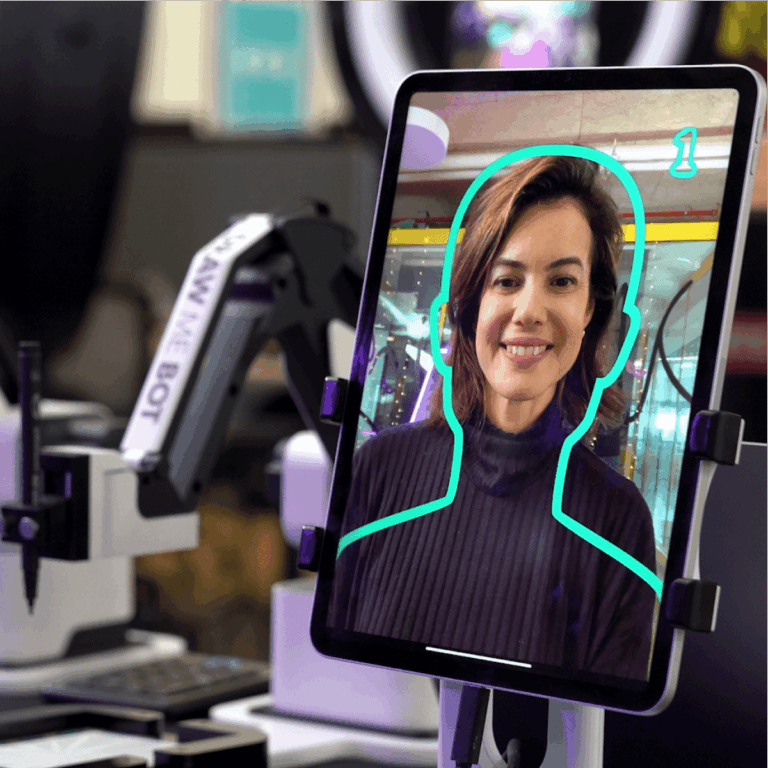
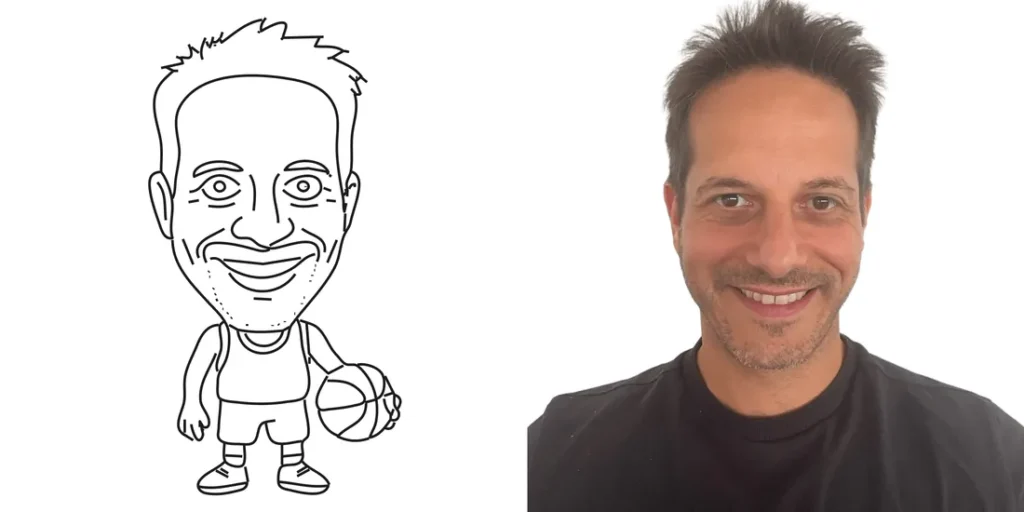
Featured image: Sample Robo Portraits caricature beside the source photo.
A caricature artist and a portrait-drawing robot have more in common than you might expect.
Both can give guests something to watch. Both can create individual portraits. Both can send people home with a physical drawing.
But the experience around that drawing is very different.
Choose a live caricature artist when the artist’s personality, conversation and personal interpretation are important parts of the entertainment.
Consider robot portraits when you want the technology itself to be part of the attraction—guests take a photo, choose a style and watch a physical robot draw the portrait in pen.
Neither choice is automatically better.
The useful question is:
What do you want guests to remember about getting their portrait?
Robot portraits vs caricature artist at a glance
| What matters | Robo Portraits | Live caricature artist |
|---|---|---|
| Main experience | Watch a robot turn a photo into a pen drawing | Sit or stand with an artist while they interpret and draw you |
| Human interaction | Attendant helps guests; the robot is the attraction | Direct interaction with the person creating the drawing |
| Drawing style | Guest chooses from the available portrait styles | Defined largely by the individual artist’s style |
| Takeaway | Physical pen-drawn portrait | Usually a hand-drawn portrait; exact format depends on the artist |
| What others watch | Robot arm and pen creating the portrait | Artist drawing and interacting with the guest |
| Capacity | Plan around about 22 portraits per robot-hour | Ask the specific artist for realistic faces per hour |
| Scaling up | 1–3 robots; approximately 45 / 90 / 130 portraits over two hours | May require additional artists; confirm availability and output |
| Couples/groups | Available; affects drawing time and capacity | Often possible; ask how groups affect time |
| Best fit | Technology spectacle + physical portrait | Human interaction + artist interpretation |
The simplest distinction is this:
With a caricature artist, the artist is part of the entertainment. With Robo Portraits, the robot is part of the entertainment.
Live artist
- Personality
- Conversation
- Individual artistic style
- Human interpretation
Robo Portraits
- Technology
- Moving robot arm
- Guest style choice
- Parallel robot capacity
What happens with Robo Portraits?
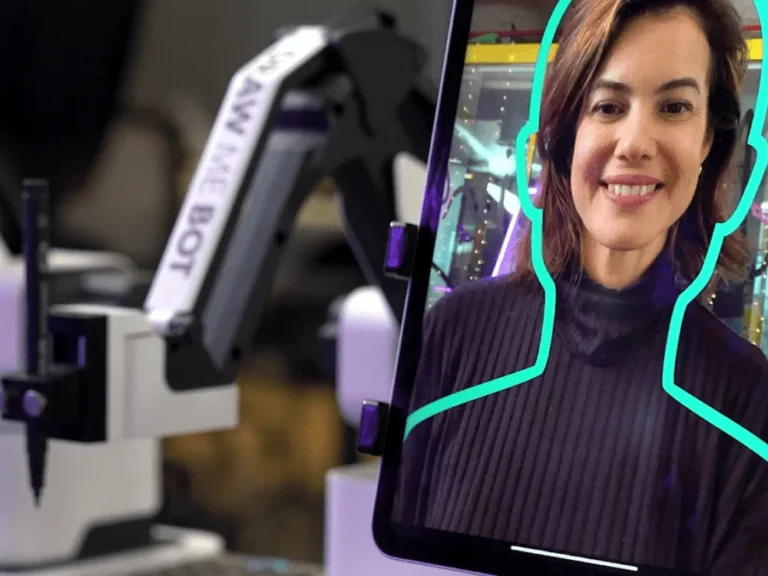
The guest starts at a photo tablet.
They take a photo, choose a portrait style and then watch the robot draw.
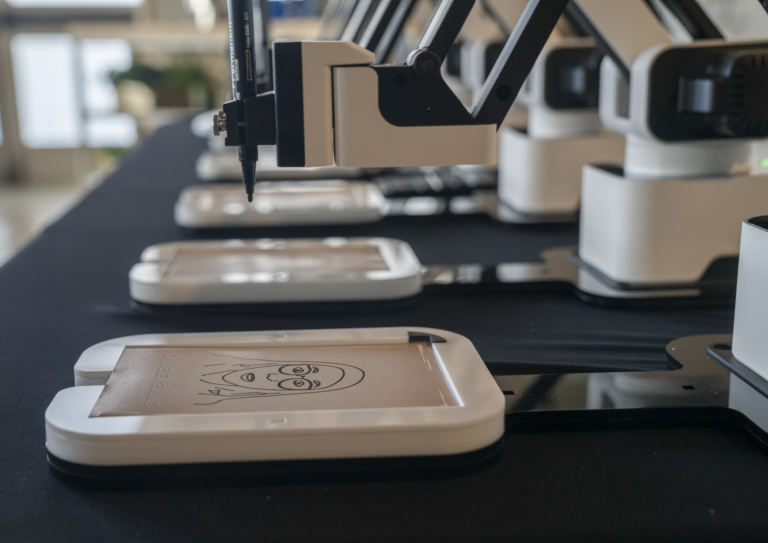
A physical pen moves across the card while the drawing develops line by line. The finished portrait is handed to the guest to take home.
The current Robo Portraits process includes both realistic line portraits and caricature styles, with simple and detailed versions available. Robo Portraits
See how Robo Portraits works from the guest photo to the finished pen drawing.
The important point is that the photograph is only the starting point.
The entertainment is what happens next.
Someone walking past does not need to know the guest being drawn to understand what is happening. They can see a mechanical arm moving a pen across the page and stop to watch.
That gives the experience a distinctly technology-driven feel.
What happens with a live caricature artist?
The guest sits or stands with a real person who draws them.
That changes the experience immediately.
The artist may talk to the guest, react to them, decide which features to emphasize and bring their own drawing style to the portrait.
For some events, that is exactly the attraction.
You are not only hiring someone to produce drawings. You are hiring that particular artist.
Their:
- personality;
- drawing style;
- sense of humour;
- speed;
- level of exaggeration;
- way of interacting with guests
all influence the experience.
That makes reviewing the artist’s event portfolio particularly important.
Do not hire a caricature artist based only on the category.
Hire the artist whose work and manner suit your guests.
Choose the caricature artist when conversation is part of what you want
This is the clearest advantage of a human artist.
A good caricature artist can talk with the person they are drawing. Guests can ask questions, joke with them and see how the artist interprets their features.
At a small wedding, birthday or social event, that interaction can be a large part of the appeal.
You might prefer this when you picture guests saying:
“I want to sit down and see what this artist does with me.”
rather than:
“I want to see the robot draw me.”
Those are genuinely different experiences.
A human artist may also adapt their manner to the individual sitting in front of them in ways that are inherent to a person-to-person interaction.
If that relationship is important to the event, do not overlook it just because a robot feels newer.
Choose Robo Portraits when the machine itself should be part of the attraction
Robo Portraits is not trying to replicate the experience of sitting across from a human caricaturist.
The machine changes the attraction.
Guests can see the robot arm move.
They can watch the pen draw.
Friends can stand nearby while the picture develops.
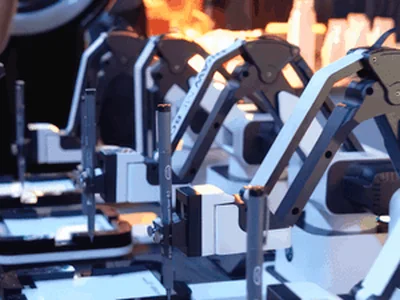
That means the production process is conspicuous.
The question people ask is not only:
“What is my portrait going to look like?”
It can also be:
“How is that thing drawing a person?”
That makes Robo Portraits a natural fit when technology, novelty or watching machinery operate suits the event.
A corporate reception, trade show, gala or modern wedding may value that visual element more than the conversation with an artist.
For a smaller gathering where the warmth and personality of the entertainer matter more, the live artist may have the stronger appeal.
The drawing styles work differently
This is an important distinction.
With a live caricature artist
The artist’s style is part of what you are buying.
One artist may draw gentle likenesses.
Another may exaggerate noses, hairstyles or facial expressions heavily.
Another may create cleaner portrait-style sketches rather than comic caricatures.
Look at enough samples to understand what your guests will actually receive.
Do not assume that every person who describes themselves as a caricature artist produces the same kind of work.
With Robo Portraits
Guests can choose between available styles.
Robo Portraits currently offers:
- realistic line portraits;
- caricatures;
- simple versions;
- detailed versions.
Full-body, group and pet portraits are also available.
The style decision therefore happens at the station rather than being determined entirely by which artist you booked. The live How It Works page shows examples of the different outputs. Robo Portraits
See the portrait styles and How It Works guide.
That can be useful at an event with mixed preferences.
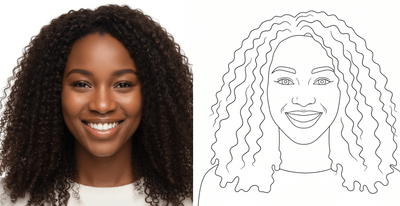
Someone who wants a cleaner likeness can choose differently from someone who wants the more playful caricature treatment.
Do not assume every caricature artist draws at the same speed
Capacity deserves special attention because internet estimates can be misleading.
Published event-caricature guidance often cites roughly 10–15 faces per hour as a common range, but experienced artists also emphasize that actual output varies substantially with the artist, style, detail, colour and whether several people are included in one drawing. One event caricaturist reports having seen professionals range from roughly four or five people per hour to 20 or more. Caricatures by Kathy
That is why the useful question is not:
“How fast are caricature artists?”
Ask:
“How many people can you realistically draw per hour in the style I am booking?”
Also ask whether that figure means:
- individual people;
- finished sheets;
- couples;
- or groups.
A drawing containing four faces is not necessarily equivalent to four individual drawings.
Robo Portraits uses a defined planning assumption
For Robo Portraits, use approximately 22 portraits per robot-hour when planning an event.
That produces these approximate two-hour capacities:
| Setup | Approximate two-hour capacity |
|---|---|
| 1 robot | 45 portraits |
| 2 robots | 90 portraits |
| 3 robots | 130 portraits |
These are planning estimates.
They do not guarantee that every person attending receives a portrait. Actual throughput depends on portrait style and event conditions.
This also does not mean a robot will always serve more people than a caricature artist.
A fast artist may draw more quickly than another artist. Multiple artists can also be hired for an event.
Compare the actual setup you are considering.
For example:
Option A: two Robo Portraits robots for two hours = approximately 90 portraits.
Option B: two caricature artists for two hours = ask those two artists exactly how many guests they expect to draw in the chosen style.
That is a meaningful comparison.
“Robots are faster than artists” is not.
Do not compare generic speeds.
Ask the artist for their people-per-hour capacity in the style you are booking. Compare that with Robo Portraits’ planning capacity for the exact robot count and drawing window.
Capacity only matters after you decide how many people need portraits
Suppose you are planning a wedding with 150 guests.
You could begin by asking:
“How do we draw 150 people?”
But that may be the wrong problem.
If portraits are one optional activity during cocktail hour or the reception, perhaps you expect 60, 80 or 100 people to participate.
Other guests may be eating, talking, dancing or simply watching.
Your participation target should drive the capacity decision.
If receiving a drawing is a central part of the event and you want virtually everyone to get one, tell the provider that explicitly.
Our capacity-planning guide explains how robot count, drawing time and expected participation fit together.
Which is better for people watching?
Both can be very watchable.
They are simply watchable for different reasons.
Watching a caricature artist
You see a person make artistic decisions.
A few marks become a face.
The artist may talk to the guest, make a joke or reveal the drawing at the end.
People who enjoy art may particularly appreciate seeing someone draw quickly from life.
Watching Robo Portraits
You see the mechanism working.
The robot arm moves the pen across the card while a recognizable portrait develops.
The contrast between a mechanical device and the personal subject it is drawing is part of the appeal.
The current Robo Portraits comparison guide describes both a live artist and the robot as drawing experiences people can watch, while distinguishing the artist’s personality from the robot’s visible pen movement. Robo Portraits
So “watchability” alone probably will not settle the decision.
Ask what you want people to be watching.
Which gives the more personal experience?
That depends on what you mean by personal.
If you mean:
“A person studies me, talks to me and interprets me through their own drawing style,”
the caricature artist has a clear advantage.
If you mean:
“The output is based specifically on me and I leave with my own portrait,”
both can provide that.
Robo Portraits should not be sold as a substitute for human artistic interaction.
That is one of the things a live artist does particularly well.
Instead, the robot experience offers a different kind of personalization: your image becomes the input for a portrait that you then watch a machine physically draw.
Which is better for quieter guests?
Neither requires a guest to participate.
Someone can watch a caricature artist work without sitting for a drawing.
Someone can watch the robot draw another guest without having their own portrait made.
That makes both potentially useful as optional activities at events where not everyone wants to perform in front of a room.
But consider the nature of the interaction.
A guest who enjoys talking one-on-one with an entertainer may prefer the artist.
A guest who would rather interact with a process and watch from the side may find the robot easier to approach.
There is no reason to force everyone through either experience.
What about couples and group drawings?
Ask before booking.
Robo Portraits can create group portraits, but groups affect drawing time and therefore capacity.
A caricature artist may also draw couples, families or other groups, but the time required depends on the individual artist and style.
The capacity question should therefore be expressed in people or faces, not only sheets of paper.
If half your wedding guests are expected to request couple portraits, tell the provider.
If your corporate event is primarily about individual employee keepsakes, say that too.
Small differences in how people participate can substantially change the flow of a drawing station.
Which works better for a wedding?
Both can make a lot of sense.
Consider a live caricature artist when:
- you want the artist’s personality to be part of cocktail hour or reception;
- you like a particular artist’s drawing style;
- direct guest-to-artist interaction suits your wedding;
- you want the drawings to feel closely associated with one individual artist.
Consider Robo Portraits when:
- watching the robot is part of the entertainment you want;
- you want guests to choose between realistic and caricature-style output;
- you want multiple robots drawing simultaneously;
- the technology fits the atmosphere of the wedding;
- you want to plan around a defined participation target.
For weddings, wedding socials and grads, Robo Portraits starts from $1,195 CAD before applicable taxes for two robots and two hours.
That package includes staffing, setup, operation and physical portraits on standard Robo Portraits cards.
See how Robo Portraits fits into a wedding.
Which works better for a corporate event?
The distinction can become even clearer at a company function.
A caricature artist can provide a warm, human entertainment experience. Guests talk directly with the person making their portrait.
Robo Portraits brings a technology demonstration into the room at the same time as it creates the keepsake.
So ask what suits the organization.
A professional association dinner may prefer the relaxed human interaction of an artist.
A technology company, product launch or event where people enjoy seeing equipment operate may find the robot concept particularly on-theme.
A general staff party could work with either.
For staff and corporate events, Robo Portraits starts from $1,395 CAD before applicable taxes for two robots and two hours, including staffing, setup, operation and physical portraits on standard cards.
See the current staff and corporate-event setup.
Which works better at a gala?
Again, consider the tone.
A live sketch artist can feel elegant and personal.
A robot can create a more technology-forward spectacle.
Both can function as drop-in entertainment while guests circulate.
Both also have finite capacity, so neither should be booked without thinking about participation and timing.
If the gala includes speeches, awards, an auction or another formal program, decide whether the drawing activity should continue or sit outside those windows.
For the wider program, see our gala entertainment planning guide.
Compare the quotes properly
Do not compare only the hourly number.
A caricature artist may quote based on:
- hours;
- number of artists;
- portrait format;
- level of detail;
- travel;
- special requests.
Robo Portraits packages are structured differently.
For Robo Portraits, standard packages include staffing, setup, operation and physical portraits on standard Robo Portraits cards. Custom cards are optional.
Relevant public starting prices include:
- birthdays and small socials from $799 CAD for one robot and two hours;
- weddings, socials, grads, galas, fundraisers and schools from $1,195 CAD for two robots and two hours;
- staff and corporate parties from $1,395 CAD for two robots and two hours.
Prices are before applicable taxes.
Compare:
What happens for the guest?
How many people can realistically participate?
How long does it run?
Who staffs it?
What does each guest take home?
Those questions matter more than which provider has the lowest headline number.
For Robo Portraits, your quote shows every line before you book.
When should you choose a caricature artist?
A live artist is probably the stronger fit if you keep coming back to these ideas:
- “We love this particular artist’s work.”
- “We want guests talking directly with the person drawing them.”
- “The artist’s personality is part of the entertainment.”
- “We like the unpredictability of a person’s interpretation.”
- “We want traditional live drawing to be part of the atmosphere.”
In that case, hire a good artist.
There is no reason to choose a robot simply because it is novel.
When should you choose Robo Portraits?
Robo Portraits may fit better if these statements sound closer to your event:
- “We want people watching the equipment work.”
- “The technology is part of the attraction.”
- “We want several portraits being drawn simultaneously.”
- “We like giving guests a choice of portrait styles.”
- “We want to plan around a known robot count and approximate capacity.”
- “We want a physical drawing guests can take home.”
Then the robot experience is doing something materially different from a traditional artist.
Could you book both?
You could.
For a large enough event, an artist and robot station could even emphasize the contrast between human interpretation and machine drawing.
But there should be a reason.
If both attractions simply compete for the same guests during the same two hours, adding both may only divide the audience.
It makes more sense when:
- the event is large;
- the attractions are placed in different areas or time windows;
- you intentionally want two different styles of portrait experience;
- the budget and room support both.
More entertainment is not automatically better entertainment.
Six questions that will usually settle the decision
Ask yourself:
1. Is the person drawing important?
If yes, favour the caricature artist.
2. Is watching the machine important?
If yes, consider Robo Portraits.
3. Which actual drawing style do we like?
Compare real samples—not category descriptions.
4. How many guests do we want to draw?
Get a realistic capacity from the specific artist or robot setup.
5. Do we expect individuals, couples or groups?
Tell the provider. It can change the timing.
6. What experience fits our crowd?
Think about whether your guests are more likely to enjoy talking with an artist or gathering around technology in action.
That is usually more useful than asking which option is “better.”
Considering Robo Portraits?
Send us your event date, location, approximate guest count and the drawing window you are considering.
If you already have a participation target—such as “we would like about 80 people to get portraits”—include that too.
We can use those details to recommend a realistic robot setup and drawing window.
If you are still considering a photo booth as well, the existing comparison guide covers all three options.
Still considering a booth? Compare robot portraits, caricature artist or photo booth.
Frequently asked questions
Does Robo Portraits make caricatures?
Yes.
Guests can choose a caricature style or a more realistic line portrait, with simple and detailed versions available.
Is a robot portrait hand-drawn?
A physical robot draws the portrait with a real pen on a card.
That is different from a caricature artist drawing by hand.
The result is a physical pen drawing rather than a printed photograph. Robo Portraits
Are robot portraits faster than a caricature artist?
There is no useful universal answer.
Robo Portraits uses approximately 22 portraits per robot-hour for conservative event planning.
Caricature-artist speeds vary significantly by artist and drawing style. Published event guidance commonly cites roughly 10–15 faces per hour, but experienced artists report much wider ranges. Caricatures by Kathy
Compare the specific artist and specific Robo Portraits setup you are considering.
Can both draw couples or groups?
Robo Portraits offers group portraits.
Many caricature artists also offer couples or groups, but confirm this with the individual artist.
For either option, multiple faces can affect the time required.
Which creates a better keepsake?
That is a matter of preference.
Choose a caricature artist if you value a drawing created directly by that particular artist.
Choose Robo Portraits if the experience of watching a robot create the physical portrait is part of what you want the keepsake to represent.